About UGC Math Race
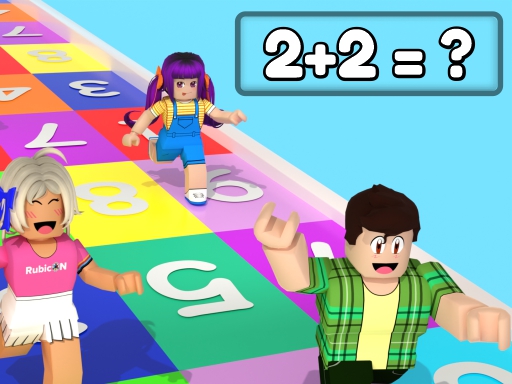
Race against time while solving math problems in a bright educational racing challenge. Each correct answer moves you forward, so fast mental math becomes the difference between falling behind and reaching the finish first.
Screenshots

How to play UGC Math Race
UGC Math Race turns arithmetic practice into a racing format: instead of pressing a gas pedal, you solve math problems that appear on screen, and each correct answer pushes your racer forward on the track. Wrong or slow answers leave you idling while rivals keep moving, so the racing pressure doubles as a built-in timer for mental math. There is no manual steering; the entire game loop is answer-and-advance, which makes it closer to a timed quiz with a racing skin than a traditional driving game.
- Tap or click the correct answer to advance
- Faster correct answers move your racer forward faster
- No steering input; movement is tied entirely to answering
Strategy tips
Because movement is tied directly to correct answers, speed of recognition matters more than speed of typing or tapping. Problems tend to draw from a narrow set of operations, addition, subtraction, and simple multiplication for younger age groups, so players who recognize common number patterns, doubles, near-tens, and small multiplication tables, answer faster than players solving each problem from scratch. A useful habit is to glance at the answer options before finishing the full mental calculation, since ruling out obviously wrong options can save time compared with computing the exact value first. Because a wrong guess still costs roughly the same idle penalty as a slow correct answer, guessing without any elimination is the least efficient approach of the three.
What makes UGC Math Race different
Most educational games separate learning content from gameplay mechanics: you finish a worksheet, then get a reward round. UGC Math Race fuses the two, the math itself is the input that drives the racing mechanic, so there is no separate practice phase and no downtime between problems. Among the games on this site, it is the only one built around an academic skill rather than reflexes, coordination, or strategic planning, which makes it a deliberate change of pace between FrontWars.io sessions.
Scoring notes
Progress is measured by race position and finishing time rather than a point total. Because every correct answer moves you the same fixed distance, finishing time is really a proxy for answer accuracy and speed combined; two players who answer everything correctly will finish at essentially the same point, so the real competitive variable is how quickly each one solves each problem.